The representative quotes were the most useful part of this test. They gave me a quick way to check whether Tiiny’s conclusions matched what the customer had said.
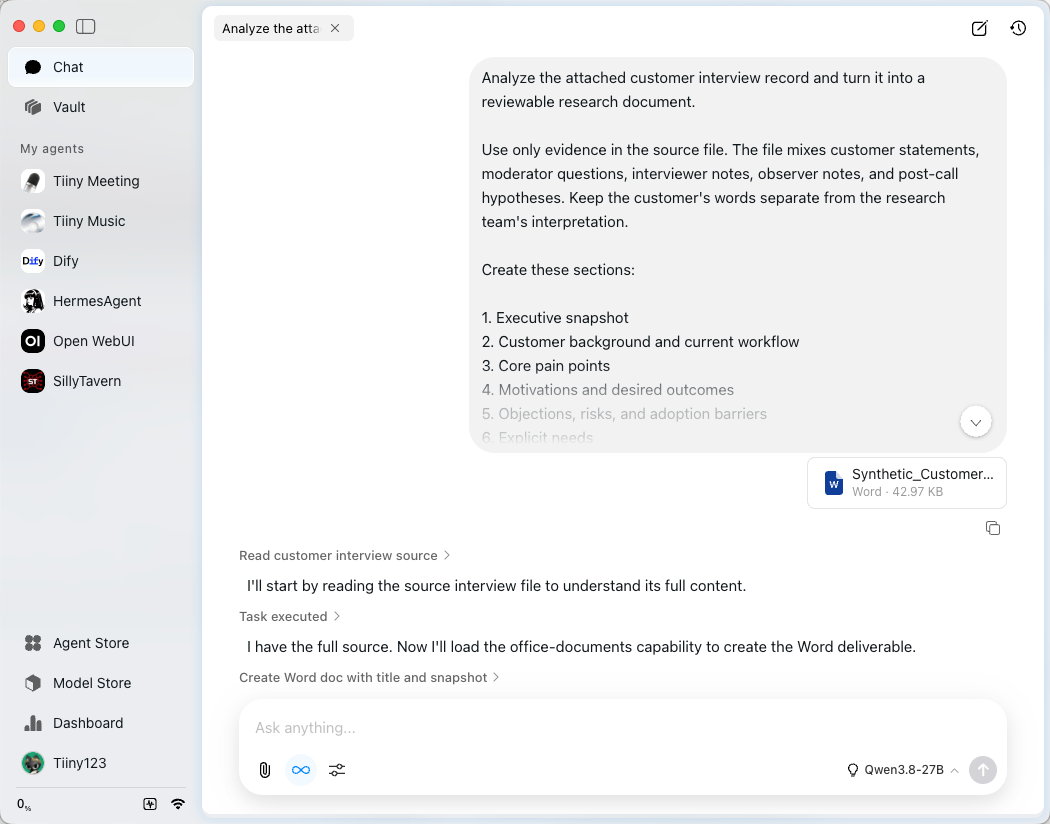
The record was not a clean transcript. It was 58 minutes and roughly 5,800 words, mixing the customer’s answers with my questions, my notes, an observer’s notes, and post-call hypotheses. Some of those notes disagreed with each other.
I ran the task locally on Qwen3.8-27B, and asked Tiiny to separate the customer’s words from my interpretation and produce a downloadable document I could review and share.
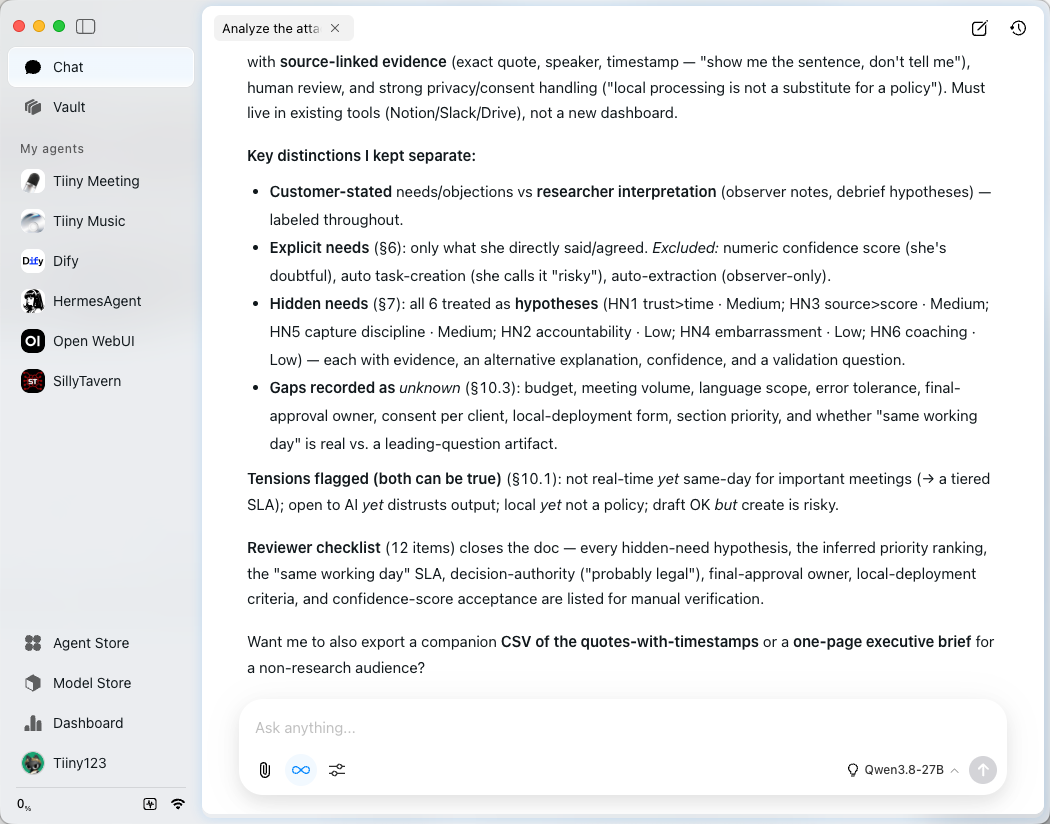
It returned a ten-section document and seven tables: sixteen pain points, each with a verbatim quote and a timestamp; seventeen explicit needs; six hidden-need hypotheses, each with an alternative explanation and a validation question; and fifty representative quotes.
It dropped an action-item idea that appeared only in the observer’s notes, because the customer had never asked for it. It also flagged my own “same working day” question as possibly leading, and suggested I re-ask it without steering the answer.
I would still examine every “hidden need” carefully. That section is interpretation by definition, and it is exactly where the customer’s words stop and mine begin.
There is also a privacy reason to run this kind of task locally. Interview records may contain names, company details, commercial information, and comments that were never meant to become public. Local processing can reduce unnecessary exposure, though consent, access controls, retention rules, and anonymization still matter.
For a first draft after a long interview, this saved me a lot of manual sorting.

No comments yet.